Showing posts with label BMW. Show all posts

Wednesday, December 22, 2010

AMAZING UNRESTORED BMW RACER AT AUCTION


With the introduction of the BMW 'R51' model in 1938, the factory had - finally - a totally up to date roadster, with advanced specification.  Proper telescopic forks, the first in the industry, were paired with plunger rear suspension and a welded, lugless tube frame, which was very light and incredibly strong, using expensive tubing which was both oval and tapered.   Norton copied the BMW forks (introduced on the 'R-7' prototype in 1934) for their Works racers, although it was fully 14 years before most other factories adopted 'teles' as standard.

The new R51 was an upgrade on the 'R5' model of 1936, which used a rigid rear end.  Some prefer the handling of the original R5, as plungers tend to wallow over bumps while cornering, a disconcerting effect.  The powerplant of the R5 was BMWs first truly modern engine, using chains inside the timing case to drive the camshafts, and a 'square' bore and stroke for its 500cc pushrod engine; quiet, smooth, and powerful.  Privateers were soon racing the R5 and R51, tuning the machine to the best of their abilities.

A clamor arose from these privateers for the BMW factory to provide racing kits and tuning advice for their mounts.  BMW responded by offering two types of racers: the R51 'SS' (SuperSport), basically a tuned-up and stripped down standard roadster, which were 'cataloged' and available -at a price- to the public (approx. 50 built), plus the R51 'RS' (RennSport), of which only 17 were built, and loaned out to carefully chosen professional racers.

The R51 'RS', while based on the roadgoing R51, wasn't merely a tuned-up roadster; it had a very different engine and gearbox, visually similar to the R51, but significantly modified for high performance.  Keen eyes can spot the 'RS', but only if they were familiar with the standard R51...more on this later. The most significant upgrades included a new crankcase which housed a gear-driven timing chest (supplanting chains to drive the cams) and a racing magneto atop the crankcase, replacing the generator of the R51 (which used coil ignition).  An early-style R5 gearbox with no air filter box housed a close-ratio racing 4-speed gear cluster.  The cylinder barrels used a distinctive 'staggered' fin pattern (see above), and the cylinder head used larger valves and inlet tracts, breathing through Amal-Fischer 'TT' racing carbs, plus a camshaft-driven rev-counter.  The specification varied for other items; some R51RS used 21" front wheels (all had 19" rear wheels) with alloy rims, some used 19" front and rear with steel rims, a few gained genuine factory racing hubs and brakes, while some, like the example here, used the steel hubs from the standard roadster. Some RS used a Rennsport racing petrol tank, some used the roadster R51 tank.  All used an open, long-taper megaphone exhaust, exactly as the 'Works' racers.  The frame, forks, and plungers were subtly modified from the standard R51 roadgoing items, similar to the 'Works' RS255 machines which were reaping race wins all over Europe at the time.

The BMW importer in New York, Emil Recke, was a keen sponsor of racing BMWs in the US, and managed to prise one of these seventeen R51RS racers out of the grasp of the factory. Under Class 'C' racing rules in the US, any motorcycle raced at an AMA-sanctioned event must be a 'production' machine, with 200 units built to satisfy homologation requirement.  If major parts were different from the road-going model, such as a bronze cylinder head supplanting an iron one (as with a Triumph Tiger 100 of the day), these parts must be freely available from the factory, to the public.  Internal modifications were allowed, but the engine, gearbox, and frame must be 'as available' in the catalog.  Clearly, the R51RS did not satisfy the rules for Class 'C' racing!

In truth, BMW sold very few motorcycles in the US in the 1920s and 30s, as protectionist trade policies introduced in the mid-20s levied a huge tax (up to 100%) on 'heavy' imported goods.  Thus BMWs were rare and very expensive in the US, and it is doubtful AMA scrutineers would recognize the difference between the R51 and 'RS', as they had probably only ever seen the model before their eyes, at the race.  Careful study of the 1939 BMW motorcycle catalog would reveal no secrets, as the factory-prepared racer wasn't in the catalog!  The 'RS' was a perfect 'sleeper', although still a pushrod 500cc ohv flat-twin...sans supercharger.

Recke's designated rider for the BMW was Joe Tomas, who used the 'RS' at Daytona in 1940 and '41, long after the rest of the Europe was bombing itself to bits. Resentment against the German racing machine reared its head during a 100-Mile race at the 1-mile dirt oval of Langhorne, Pennsylvania (the 'Indianapolis of the East'), in 1941; according to track-side stopwatches, Tomas and the BMW set the fastest qualifying lap, for which a prize of a gold watch was awarded, but AMA officials claimed their 'timer had broken' and Tomas' speed was never officially recorded.

This was only the start of Emil Recke's troubles, for when the US finally entered the War in Dec. 1941, Recke, as a German national and 'enemy alien', had his bank accounts seized by the US government.  Suddenly broke, he was forced to sell his BMW dealership, parts stock, tooling, and motorcycles to survive, for which he was paid pennies on the dollar given the ramping-up of the propaganda machine against anything, and anyone, German (or Japanese).  After selling nearly everything he owned, all he had left in the world was his most precious possession, the R51RS which had been entrusted to him by the BMW factory.  When it became clear that this, too, must be sold, he did what he had to, and sold the bike.  He then took his own life.

Indianapolis racer Rody Rodenberg was a notorious 'Harley hater', and raced anything but H-D on the dirt tracks of the US.  He also rode Triumphs and Indians, but from 1947 through 1952, it was the 'RS' pounding the sand at Daytona.  It's known he won some events on the BMW, including an Indianapolis '100', and photographs of Rodenberg racing this machine can be found in Steven Wright's excellent 'American Racer' and Don Emde's definitive work, 'Daytona 200' - both still in print.

When Rodenberg was finished racing the BMW, he parked the machine, and the current condition is exactly as he left it, 'as last raced'.  Only 3 genuine R51RS motorcycles are confirmed to exist, one of which sits in the BMW Museum in Munich.  This is the only unrestored example, although replicas abound on the vintage racetracks of Europe.

This 1939 BMW R51RS  is coming up for auction at the Bonhams Las Vegas sale on Jan. 6, 2011.  Sale estimates range from $120k - $140k; given the utter rarity of the model, plus the complete from-new period documentation offered and confirmation of authenticity from BMW itself, I suspect the price could well exceed these figures.

Monday, December 6, 2010

BMW


BMW S1000RR 2011 type Colors
many choice of this type motorcycles color defent on our taste.
BMW S1000RR 2011 type Colors
BMW S1000RR 2011 type Colors2011 BMW S1000RR Colors

2011 BMW S1000RR Colors2011 BMW S1000RR Colors Front

2011 BMW S1000RR Colors2011 BMW S1000RR Colors Side View

2011 BMW S1000RR Colors2011 BMW S1000RR Colors Picture
Waiting for 2011 "s1000rr" gen discussions welcome to the i-bmw.com forums - you're currently viewing as a limited access guest. Bmw s1000rr tuned by ac schnitzer with photos and details bmwcoop archive 2011 s1000rr motorrad spring delivery bmw motorcycles (aka beemers) and the competition. Bmw s1000rr - webbikeworld the bmw s1000rr: unique among the competition over the years and decades, the principle of bmw 2011. 2009 bmw s1000rr bmw's 2011 motorcycle lineup is another amazing mix of machinery with something for bmw s1000rr bmw r1200gs bmw r1200gs adv bmw r1200rt bmw r1200r bmw r1200s bmw hp2 sport. 2011 s1000rr motorrad spring delivery archive - bimmerfest kilometer magazine has its first review of the new bmw s1000rr up: coming out of the long right-hand turn nine at palm beach international raceway, bmw s new s1000rr did.
2011 bmw m3 vs 2011 bmw s1000rr - mountain bike forums 2011 s1000rr motorrad spring delivery bmw motorcycles (aka beemers) and the competition. 2011 s1000rr motorrad spring delivery - bimmerfest - bmw forums 2009 bmw s1000rr bmw's first series superbike comes off the production line enduro world championship in genoa the enduro indoor world championship 2011. Vwvortex.com - km first ride - 2011 bmw s1000rr after two successful teething years in the world superbike championship, bmw motorrad race team has signed leon haslam to pilot the second s1000rr alongside troy corser. Bmw motorrad wsbk team signs leon haslam for 2011 2011 bmw s1000rr release date bmw s1000rr 2011 bmw 2011 s1000rr s1000rr performance parts pictures of bmw s1000rr bmw s1000rr bmw s1000rr for sale s1000rr.

Tuesday, November 9, 2010

OFF THE HOOK PARISIAN BMW DISPLAY


Had a Parisian friend not tipped me off, I would have entirely missed a one-two punch of vintage BMWs at an unlikely venue, Salon de la Photo, a photographic equipment trade fair at the Porte de Versailles, Paris.  What BMW of France had in mind bringing two of their most coveted and rare old machines to a camera show is outside my purview, but it provided moto-journalists with some exciting subject matter in a gigantic hall (one of 6), otherwise filled to the elbow-bump with photogeeks and bored models.

The BMW display included 8 machines of interest, 6 being new, 4 commissioned as 'art projects', one prototype (the 'Concept 6'), the 2010 French Superbike champ, plus the two whose vintage cred yanked me across Paris on a rainy day just before the show was shuttered up.  The BMW.Fr staff on hand was friendly but small, as their offices had been taken hostage that morning by a shotgun-wielding nutbag.  In the States we call this 'going postal', but in this case it was an extreme case of 'service feedback'.

BMW France is to be congratulated for a motorcycle-show-worthy display of fascinating machines, and of course, of special interest to readers of the Vintagent are the ultra-rare RS255 Kompressor Rennsport of 1939, and unique 'R7' Art Deco prototype.  The 'Concept 6' prototype (above) provided glaring contrast to the pair of vintage machines, being huge and heavy, immensely powerful, and designed to the hilt.  Still, an awesome brute, with a whiff of Terminator perfume lingering over its post-Transformers bodywork.

In the late 1920s, BMW developed a new chassis for its motorcycles from molded sheet steel, and moved away from the Bauhaus simplicity of their tube-frame 1920s designs.  With the petrol tank nestled between the twin halves of shapely pressed-steel frame,  the new models gained a contemporary Art Deco flair, tempered on most production models by simple mudguards and their typical basic-black paint scheme.  The pressed-steel frame begged an aesthetic question which proved too compelling to ignore, given industrial trends of the period for streamlining and 'Airflow' shapes.  I'm not certain if BMW automotive designers lent a pencil to the prototype 'R7' model on display here, but it breaks Teutonic motorcycle tradition with its exuberant embrace of the Deco aesthetic.

The tension between form and function on motorcycles is the very essence of their visual allure, and lovers of the mechanical celebrate those models which find balance, proportion, and harmony of exposed machinery, with the structure required to hold the sum together.  Philosophically and in the marketplace, motorcycles which read as design exercises in sheet metal were never considered successful - this was the realm of the automobile, the train, the airplane, whereas motorcyclists of the Vintage and Classic period, being almost to an individual dedicated gearheads, want the fiery beating hearts of their mounts visible in all their complication; this is our enduring delight.

That the 1934 R7 prototype is a design success is without question; it's a graceful and beautiful study of flowing lines, curves, and feminine masses.  Almost to a person, especially to non-motorcyclists, it is considered one of the most beautiful motorcycles of the 1930s.  Today it is the most blogged-about BMW of all, but photoblogs don't have much to say about the essential qualities of Motorcycling, or the reason why BMW chose not to proceed from this uniquely attractive design study. As good as it is, the R7 is a total philosophical departure from what is best about BMW during its first 60 years; restraint. The extravagance expressed by the R7 is shockingly French, more Delahaye than 328.  That the R7 was never serially produced breaks the hearts of many, but it makes complete sense.

The Type 255 Rennsport on display is in effectively 1939 spec, rare indeed although I don't know if this is the ex-John Surtees machine, reputedly the only late Kompressor in pre-war trim, as post-war, while German riders and machines were banned from international competition, they continued to race in German national championships, and the blown racers were developed and modified until 1950, when BMW was invited back to international competition.  Superchargers were banned from the GP scene in 1946, so BMW developed an entirely new line of racing machines without their famous Kompressors.

This RS255, while officially residing in the BMW Museum in Munich (click here for my story), regularly stretches its legs on circuits around the world. at Vintage events...and I note the front mudguard has a 'Goodwood 2010' scrutineering sticker, so it has been used recently indeed.

The late Kompressor BMW is an astounding machine, developed into the best racing motorcycle in the world during the three years it competed on the global stage.  Weighing only 304lbs (that's 30lbs less than a Works Norton, and perhaps 50lbs less than the rival supercharged Gilera 4-cylinder dohc machine), the single-overhed-camshaft engine produced around 60hp, ten more than the Norton, but ten less than the Gilera.  Measured top speed was in the region of 136mph.

The extremely light weight of the BMW gave it an advantage in all respects during a race, making it easier to manage, with faster acceleration.  The handling was good, albeit inevitably quirky with torque reaction from the shaft final drive.  The plunger rear suspension with friction scissor-type damping was identical to the Nortons, and while helping to keep the rear wheel in contact with the ground, defects in the design meant the odd rocking-horse feel was an acquired taste for a rider; not all found harmony.  Luckily for BMW, their star pilot was among the bravest fellows ever to grace a GP circuit, Georg Meier, and his tremendous skill combined with sheer toughness overcame whatever handling issues the BMW shared with its rivals, and he won most of the races he entered on the RS, including, most famously, the 1939 Isle of Man TT.

To crawl all over these machines at the end of a Paris trade show was an unexpected treasure, so many thanks to Martin Jouët for alerting me, so I could share them with you!

Monday, November 1, 2010

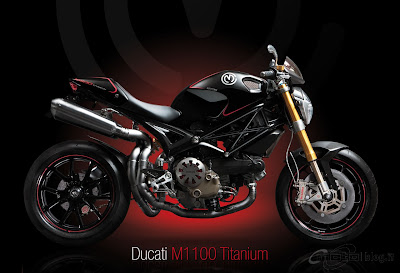
Amazing Ducati Monster

Ducati Monster Titanium Sport BikeDucati Monster Titanium Sport Bike

Ducati Monster Titanium Disc BrakeDucati Monster Titanium Disc Brake

Ducati Monster Titanium EngineDucati Monster Titanium Engine

Ducati Monster Titanium Double ExhaustDucati Monster Titanium Double Exhaust

BMW Touring Motorcycles

K1600GT-Intermot.jpg

BMW finally released images of its K1600GT and K1600GTL touring motorcycles when it pulled the cover of its new six-cylinder touring bikes at the INTERMOT Bike Show in Cologne, Germany. The Bavarian marque released introductory info on the Inline Six designs in July, but saved the full reveal for INTERMOT.

Stylistically the new Beemer sticks close to the concept drawings teased with its earlier announcement. A notable change from BMW’s previous touring models, the fairing shape doesn’t extend fully down the entire side of the bike. Instead the KT1600 leaves the engine sides exposed, revealing the 55-degree forward slant of the Inline Six.

The new powerplant claims peak power of 160 horsepower. The six-cylinder mill churns out 129 lb-ft of torque, with BMW touting 70% of the peak torque at 1500 rpm. The new mill weighs in at 226 pounds and is just 22 inches wide. Viewed from the front, the K1600GT looks no wider than its smaller-displacement K series kin.

K1600GT-intermot-debut.jpg
K1600GTL.jpg
The models unveiled at INTERMOT reveal a heavyweight touring platform. Integrated luggage and adjustable screen are obvious additions. The seating and passenger accomodations for the GTL tourer look downright Gold Wing-esque – the Flat Six-powered Honda its seeming head-to-head rival.

Wednesday, October 20, 2010

BMW Recalls 2004-2010 K1200 and K1300 Motorcycles for Bearing Problem

BMW is recalling certain model year 2004-2010 K1200 and K1300 motorcycles.

The bearings could be subject to corrosion. This could lead to reduced movement of the link lever.

The number of units has not been specified.

Check out my Motorcycle Recalls feature for more details.

BMW Recalls 2007-2010 F650GS Motorcycles for Brake Problem

BMW is recalling certain 2007 through 2010 F 650 GS motorcycles manufactured from November 2006 through January 2010.

A washer may interfere with the front disc brake fasteners' torque. As a result, over time, a fastener or multiple fasteners could become loose, allowing the brake disc to become loose.

1835 units are affected.

Check out my Motorcycle Recalls feature for more details.

Wednesday, October 6, 2010

BMW launch K 1600 GT and K 1600 GTL at INTERMOT


BMW have launched not one but two new models powered by their new in-line six cylinder 1600cc engine at the German motorcycle show at INTERMOT Cologne this week.

The K 1600 GT is described as the "the new benchmark for dynamic, cross-continent touring", whilst the K 1600 GTL is described as "the pinnacle of luxury, long-distance motorcycle touring". You can find out more about these two luxury BMW motorcycles on www.inter-bike.co.uk.

Ride safe.

Jon Booth
Email: webmaster@inter-bike.co.uk
Blog: http://bestmotorstyle2011.blogspot.com//
Swicki: http://motorcycling-swicki.eurekster.com/

AddThis Social Bookmark Button

Wednesday, July 21, 2010

BMW Recalls 2005-2009 R1200RT Police Bike for Faulty Signaling Device Bracket

BMW is recalling certain 2005 through 2009 R 1200 RT police motorcycles manufactured from April 2005 through September 2009.

The bracket which supports the audible signaling device can break, possibly allowing the signaling device to fall from the vehicle and into the roadway.

1900 units are affected.

Check out my Motorcycle Recalls feature for more details.

Monday, July 12, 2010

UNIQUE BLOWN BMW FOR SALE


In 1958, Walter Zeller ordered a very special BMW from the factory, to be built entirely to his specification and to suit his riding style.  As Zeller had been the principal Works racing rider for many years, gaining several German championships and 2nd in the World Championship in 1956, BMW management granted him this solitary exception to their rule of 'no custom orders'.  That the factory presented the finished product as a gift for his services to BMW is the stuff of legend; the ultimate BMW trophy.

The machine is a mélange of interesting parts; a 600cc ohc Kompressor motor from Max Klankermeier's '49 sidecar racer (blowers were still allowed in German national championship races after '48), housed in a special Rennsport-based swingarm frame, utilizing telescopic forks from the 1951 Works development racer, instead of the Earles type on the racers and contemporary BMW roadsters.  The forks are a very interesting choice; did Zeller feel that his racing BMWs  handled poorly with their Earles forks?  If Zeller 'voted with his feet', the answer is yes, he preferred a standard telescopic fork to the Earles item.  Quite a statement for a Works rider to make, actually!  To quote Josef Achatz (the foreman of the build team for this bike), "Walter preferred telescopics".

Lighting was added to the front and rear, again interesting choices, for while the headlamp is as per the roadsters, but with a tachometer replacing the speedo, the taillamp is a seriously prewar item, as used on mid-30s machines; the Bosch equivalent of the ubiquitous MT110 Lucas taillamp, used on just about every British bike in the 30s and through WW2.

The tank is as per the Works machines, as is the seat, while the exhaust is the fishtail type as used on the R51 and other models pre- and post-war.  It would have squelched the power of the blown engine, if any baffles were fitted, which is an open question; why have a supercharged engine with a power-strangling muffler? But, the original TUV specification papers state the sound output as 73db; terribly quiet for a racing bike.  Top speed is quoted at 112mph (180kph), which is certainly down on any of the supercharged racers, which were at least 30mph faster through the speed traps.  Weight is quoted in the TUV document at 388lbs (176kg), but Zeller had the machine weighed at a steel factory (St. Anna-Huette; Zeller's family business), which quoted 317lbs.  This is very close to the '39 TT-winning bike of Georg Meier, which was 30lbs lighter than the competition.

Zeller kept the machine for many years, and used it occasionally on the road.  As there is no kickstarter, he bump-started the bike; in this, his racing years gave him expertise.  According to news reports, it took him 'ten or a dozen starts' to sort out the right combination of throttle, magneto, and air levers - after this, his technique was flawless.  Once the bike was warm, the plugs would be changed to a harder grade... it's clear this one-off BMW required a bit more forethought to ride than the typical 'no fuss' flat twin.  As there was no room for a generator, the lights are total-loss, making this strictly a daytime ride.

Contrary again to the TUV papers, Zeller reported the bike would acclerate from 0 to 100kph in under 5 seconds, and that 200kph (124mph) was 'no problem'.  In 1958, there was only one other road-going machine capable of such speeds, and the Vincent Black Shadow had double the engine capacity, was 140lbs heavier, and had been out of production for 3 years!  Zeller must have cut quite a romantic figure on the Alpine roads he favored (Queralpenstrasse and others), passing literally everything on wheels, drawing a large crowd whenever he stopped, then bump-starting away, leaving only a fantastic noise, and a slight haze from the 2% oil mix lubricating the supercharger.

Alas, times were difficult for Zeller's family business in 1963. He had been pressed by a persistent pesterer, a schoolteacher no less, to sell the machine.  Norbert Reisbeck phoned Zeller every month for over a year, asking again and again if he could buy the magical BMW.  In what must have been a black month, Zeller caved in, and sold the machine for 7,000DM in 1963.

After the death of Reisbeck, a new owner began to advertise the machine for 3million euros a couple of years ago.   As a reality check, the ex-Georg Meier '39 TT winning BMW Rennsport sold for around £250,000 six years ago, according to rumor, so a machine with no racing history but an intriguing story should surely sell for far less.  The price dropped to only 1M euros this year (via an ad in Motor Klassik last April), and the bike is currently still available  Any takers?


(The source of photos 2-6 are from an article on this machine by Ernst Leverkus in The Classic Motorcycle, April 1986)